
Author name

Measure Twice, Fit Once

Little did I know I needed such an instrument

Designing electronics for a beehive taught me very quickly that a ruler—and certainly my eyeball—wasn't going to cut it. Enter my first digital caliper.


Every millimeter matters. Components have to fit the circuit board, the board has to fit its enclosure, and the finished device has to fit into a working colony without interfering with the bees. That means measuring accurately, checking the specifications, and then measuring again. And again.


One particularly important constraint is “bee space”—the roughly 6–9 mm (¼–⅜ inch) gap bees naturally maintain for movement. Make a space too large and bees may fill it with comb; make it too small and they may seal it with propolis.


I've learned a basic engineering lesson: use the right tool, measure accurately, and never be embarrassed to measure one more time.

June 30, 2025
When the Ocellus project began, its Project Head came from healthcare and behavioral science—not electrical engineering. So when the engineers started talking about selecting an “MCU,” the first question was pretty basic: What's an MCU? A microcontroller unit, or MCU, is essentially the small computer at the heart of an embedded electronic device. It combines a processor, memory, and interfaces for communicating with sensors and other electronics on a single chip. For Ocellus, choosing one meant learning enough to ask the right questions: How much processing power do we need? How much memory? How will it communicate with our sensors? How much energy will it consume? How difficult will it be to program—and how physically large is it?  Lesson learned: leading an R&D project doesn't require knowing everything. It does require learning enough to know what questions to ask.
June 22, 2025
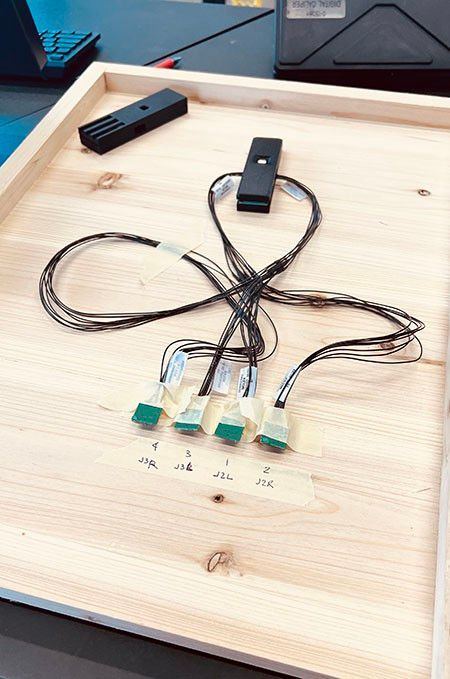
To effectively monitor and analyze the acoustic environment inside the hive, we realized that the microphone needed to be on its own dedicated board. This design decision provides for maximum flexibility, letting us place each microphone precisely where it's needed within the hive. With four microphones, each on its own board and connected to the main PCB, we can simultaneously record sound from multiple locations within the hive. This setup is essential for capturing a comprehensive sound profile, which will be invaluable for understanding hive health and behavior through acoustic analysis. By isolating the microphones on separate boards, we ensured that the sound data collected is as accurate as possible, free from interference or noise that might arise from other components on the main PCB. This design also allows for easy repositioning and testing during the prototype phase, allowing me to experiment with different configurations to find the most effective setup for capturing the subtle sounds bees make. The result is a versatile and powerful tool for non-invasively monitoring the hive, providing critical insights without disturbing the bees.
June 21, 2025
Once we selected the appropriate processor and sensors, it was onto the PCB design